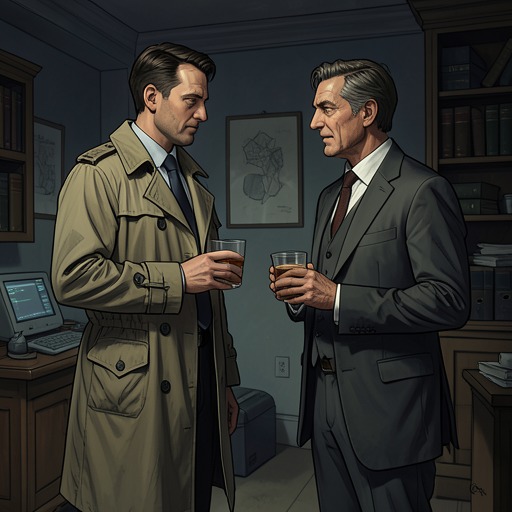
Hauser and O’Brien’s police partnership
Naked LunchHauser and O’Brien’s police partnership is a twenty-year City Narcotic Squad team whose division of labor—Hauser as the hard man, O’Brien as the conversational operator—turns a routine arrest into the setting for Lee’s escape. Their practiced coordination makes them recognizable figures in the drug-enforcement world, but it cannot withstand Lee’s desperate, carefully timed reversal.
Service and Division of Roles
Hauser and O’Brien have served together on the City Narcotic Squad for two decades. Lee, who has spent sixteen years addicted to drugs, considers them old hands like himself and distinguishes between their styles. O’Brien is the con man of the pair; Hauser is the tough one. Their partnership is described as a vaudeville team, an image that captures both their contrast and their complementary performance in police work.
Hauser’s method is physical intimidation: he tends to strike a suspect before speaking, ostensibly to break the ice. O’Brien follows with an Old Gold cigarette and a conversational police routine, using familiarity and persuasion to draw the suspect into an exchange. Lee regards the approach as effective, if unpleasant, and does not describe O’Brien as a bad man. His assessment gives the partnership a measure of professional familiarity: the officers are not strangers encountered for the first time, but experienced operators whose established habits Lee can read.
The Assignment to Arrest Lee
The partnership’s final operation begins when Hauser receives a call from his lieutenant at breakfast. He and his partner are told to pick up William Lee at Room 606 of the Hotel Lamprey. The lieutenant specifically instructs them not to spend time searching the room, but to bring in all books, letters, manuscripts, and other written or printed material. Hauser recognizes Lee and remembers him; the order’s emphasis on his papers makes the pickup more than an ordinary arrest, though the officers are not given an explanation for it.
They enter with a pass key that works even when the room is locked from inside. Lee is preparing his morning injection, with his drug equipment laid out on the table. O’Brien opens with the pair’s familiar, sociable manner, greeting Lee as an old acquaintance. Hauser, meanwhile, keeps his gun drawn. Lee understands this as part of Hauser’s standard arrest practice: the weapon is meant to exert psychological pressure and discourage a sudden move toward the toilet, sink, or window.
Negotiation and Reversal
Lee asks whether he can take a shot before being taken in. Hauser refuses, and O’Brien turns the refusal into an opportunity to bargain. His warm, coaxing voice and drawn-out use of Lee’s name imply that the officers might permit the injection if Lee offers something useful. Lee responds by proposing that he set them up with Marty Steel, a careful dealer whom the police have been unable to arrest despite years of trying. Lee claims he can arrange a connection; the officers remain suspicious, but Hauser eventually agrees on the condition that Lee deliver.
The bargain momentarily restores the familiar shape of their partnership: Hauser sets the threat and terms, while O’Brien handles the conversation. Lee appears to accept their arrangement and prepares his injection. While O’Brien sits smoking and looking out the window, Hauser continues to watch the room, juggling his detective’s revolver and checking the closet. Lee’s fear centers on his suitcase, where he has access to what he needs to escape. When Hauser warns him not to deceive them about Marty, the officers’ suspicion closes in on the very object Lee needs to reach.
Lee turns the scene by using alcohol from his syringe to distract Hauser, then reaches the suitcase and takes a gun. Hauser fires, but Lee shoots him and then shoots O’Brien as O’Brien reaches for his own weapon. The contrast between their roles remains visible in the crisis: Hauser is the immediate armed threat, while O’Brien is seated apart, then reacts as the escape unfolds. Yet their practiced division of labor offers no protection against Lee’s sudden change from bargaining suspect to armed fugitive.
Ending and Significance
Lee gathers his notebooks, drug equipment, and ammunition into a briefcase, leaves the room, takes the self-service elevator, and walks out through the hotel lobby. He knows that escape offers only a chance, not security, but prefers it to becoming a subject for experiments. The partnership therefore ends not in a completed arrest or successful interrogation, but in the deaths of both officers and Lee’s flight from the hotel.
Their characterization also rests on the difference between routine and personal acquaintance. Lee recalls O’Brien as the less brutal member of the pair and says he did not want to do what he ultimately does, while recognizing that the encounter is his only chance. The officers’ familiar tactics—Hauser’s gun and force, O’Brien’s cigarette and insinuating patter—make them seem to control the room. The reversal exposes the limit of that authority: Lee knows the script, accepts its bargaining terms long enough to act, and escapes by turning the officers’ predictable roles against them.